
Season’s Greetings from our National Manager

Ethical Clothing Australia’s National Manager, Rachel Reilly, reflects on 25 years of impact in protecting Australian garment workers, growing our accreditation program, strengthening advocacy on procurement and modern slavery, and supporting ethical, local TCF businesses across the country.
As 2025 draws to a close, we are reflecting on what has been a very significant year for Ethical Clothing Australia. This year we marked 25 years of operations and completed the first twelve months of our five year strategic plan. This has set the framework for us to grow the accreditation program, work towards a more sustainable business model, strengthen our advocacy, and increase brand awareness and visibility of Ethical Clothing Australia across the country. Together with our partners, supporters, and the workers at the heart of this industry, we are helping to build an ethical and local textile, clothing, and footwear sector in Australia where the rights of garment workers are protected and respected.
Over the past financial year, a key focus has been growing the accreditation program while recognising the pressures facing local manufacturing. Twenty new businesses became accredited with Ethical Clothing Australia, expanding our reach across multiple states and adding a diverse mix of manufacturers, brands, and value adders across the supply chain, collectively helping to protect the rights of thousands of workers. At the same time, many businesses are feeling the pinch of local and global economic challenges, and for every new business that joined, a similar number chose not to renew their accreditation, mainly because they closed their operations or moved offshore.
In this context, advocacy has remained at the core of our work. We adopted a government engagement strategy with a strong focus on procurement policies that preference ethical and local manufacturing and recognise the commitments accredited businesses make to transparent and lawful practices. We have met with Ministers, members of Parliament, and senior officials across jurisdictions, including presenting to the NSW Procurement Board and the Australasian University Procurement Network. We contributed to two Parliamentary Inquiries in New South Wales – one on procurement and the other on reestablishing an Ethical Clothing Extended Responsibility Scheme. This Scheme compels retailers to ensure outworkers are engaged lawfully or, to become accredited with Ethical Clothing Australia. The NSW Parliament Modern Slavery Committee and the Government response supported reactivating this Scheme, and we are continuing to work with government and stakeholders to see it put into practice.We know a similar Scheme exists in South Australia, and we intend to turn our advocacy focus to South Australia in the new year.
Together, we are helping to build an ethical and local textile, clothing, and footwear sector in Australia where the rights of garment workers are protected and respected.
- Rachel Reilly | National Manager, Ethical Clothing Australia
We have also very intentionally put the private sector in our sights. Large private entities have enormous purchasing power and have legal obligations such as Modern Slavery Act reporting and environment, social, and governance commitments, and we want them to see Ethical Clothing Australia accreditation, and our accredited brands and manufacturers, as a practical solution to their ethical procurement needs.
Our model received important international recognition this year. We met with the UN Special Rapporteur on contemporary forms of slavery, whose country report to the Human Rights Council cited Ethical Clothing Australia as a standout model for protecting vulnerable workers in the textile, clothing, and footwear industry. Research by the Australian Human Rights Institute found that our multistakeholder model, which engages the union at all levels of auditing and governance, is a global leader and clear differentiator when it comes to preventing exploitation and protecting workers’ rights. We will keep leveraging these findings in our advocacy to push for procurement policies that preference Ethical Clothing Australia accredited businesses.
All of this has been underpinned by major efforts to build visibility and awareness of who we are and what accreditation means, for both businesses and consumers. Over the last financial year we delivered six major campaigns across digital, radio, outdoor, and in-person platforms, including general brand awareness, the “See the e” campaign, Buy Ethical Support Local, our Mother’s Day and Holiday Gift Guides, Fashion Revolution Week, and the Ethically Made in Australia Pop-Up, along with multilingual outreach to support union outworker engagement. In June, our Ethically Made in Australia Pop-Up brought together more than 20 accredited businesses and welcomed 825 visitors, giving people the opportunity to meet the makers and see ethical, local manufacturing in action. In October, Ethical Clothing Australia Week 2025 marked our 25th anniversary with events across four states, including a retrospective exhibition, worker testimonies, worker centric films, and conversations that highlighted the stories and experiences that have shaped Ethical Clothing Australia and the industry over the past 25 years, with 35 accredited businesses running events or joining our digital activations.
The results show that this collective effort is working. Over the past year, consumer recognition of Ethical Clothing Australia increased from 10 per cent to 16 per cent, and website traffic grew by nearly 32 per cent. Visits to the accredited brand directory increased by more than 50 per cent, and visits to the accredited manufacturer directory rose by more than 18 per cent. These numbers tell us that more people know who we are, more people are finding accredited businesses, and more people are engaging with what ethical, local manufacturing looks like in practice.
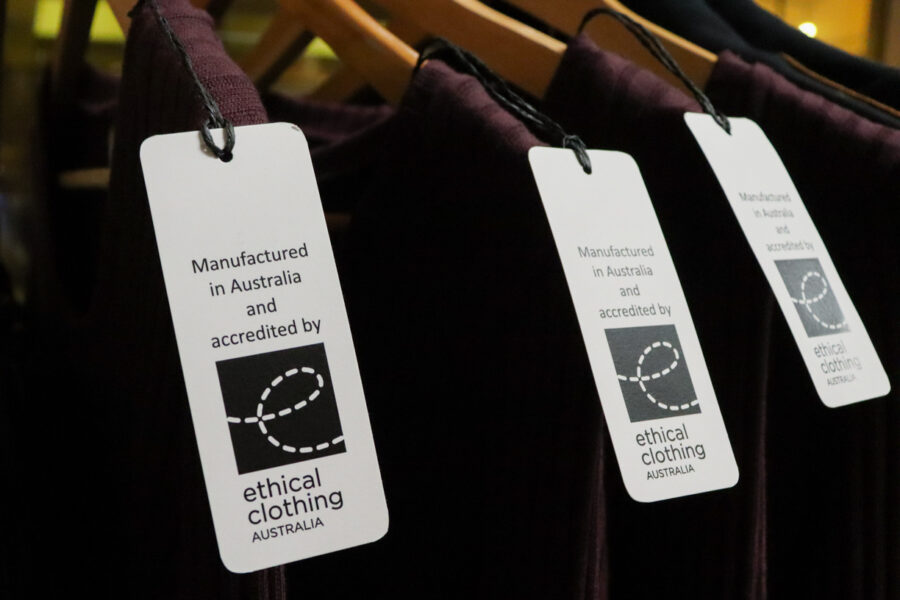
Every time you look for the Ethical Clothing Australia trade mark you are backing local jobs and fair, transparent labour practices.
- Rachel Reilly | National Manager, Ethical Clothing Australia
Alongside this, we have been working to diversify our income so we are less reliant on government grants, which have been vital in keeping accreditation fees low but are under increasing pressure. We have begun the process of applying to become a deductible gift recipient charity, which will enable us to accept tax deductible donations. Earlier this year we held a special general meeting to amend our Rules of Association to enable us to do this. We are also exploring new ways to engage the private sector to support and help scale the impact of the accreditation program.
As we move into the holiday period, our Holiday Gift Guide 2025 brings together more than 30 accredited businesses, making it easier for you to buy from local, ethically accredited brands and manufacturers. In doing so, you can be confident your gifts support fair wages, safe workplaces, and transparent supply chains. Meaningful gifts should not put workers at risk, and every time you look for the Ethical Clothing Australia trade mark you are backing local jobs and fair, transparent labour practices in a very real way. To all our accredited businesses, our partners at the TCF Union, the politicians, governments and their staff, and every person who has chosen to “see the e” this year, thank you. Together, we are building on 25 years of impact, and we look forward to working with you in the year ahead to protect more local workers from exploitation and to strengthen ethical, local manufacturing for the long term.
Related articles
Explore more insights, updates and stories from across Australia’s ethical and local manufacturing industry.

Contact us to get accredited
Support local


Ethical Clothing Australia acknowledges the Traditional Custodians of Country throughout the lands now known as Australia and recognise and celebrate their connections to land, sea and community. We pay our respect to Elders past and present and extend that respect to all Aboriginal and Torres Strait Islander Peoples today.We are a place free from discrimination, where diversity is celebrated and everyone belongs. We are committed to creating a safe and welcoming space for all.